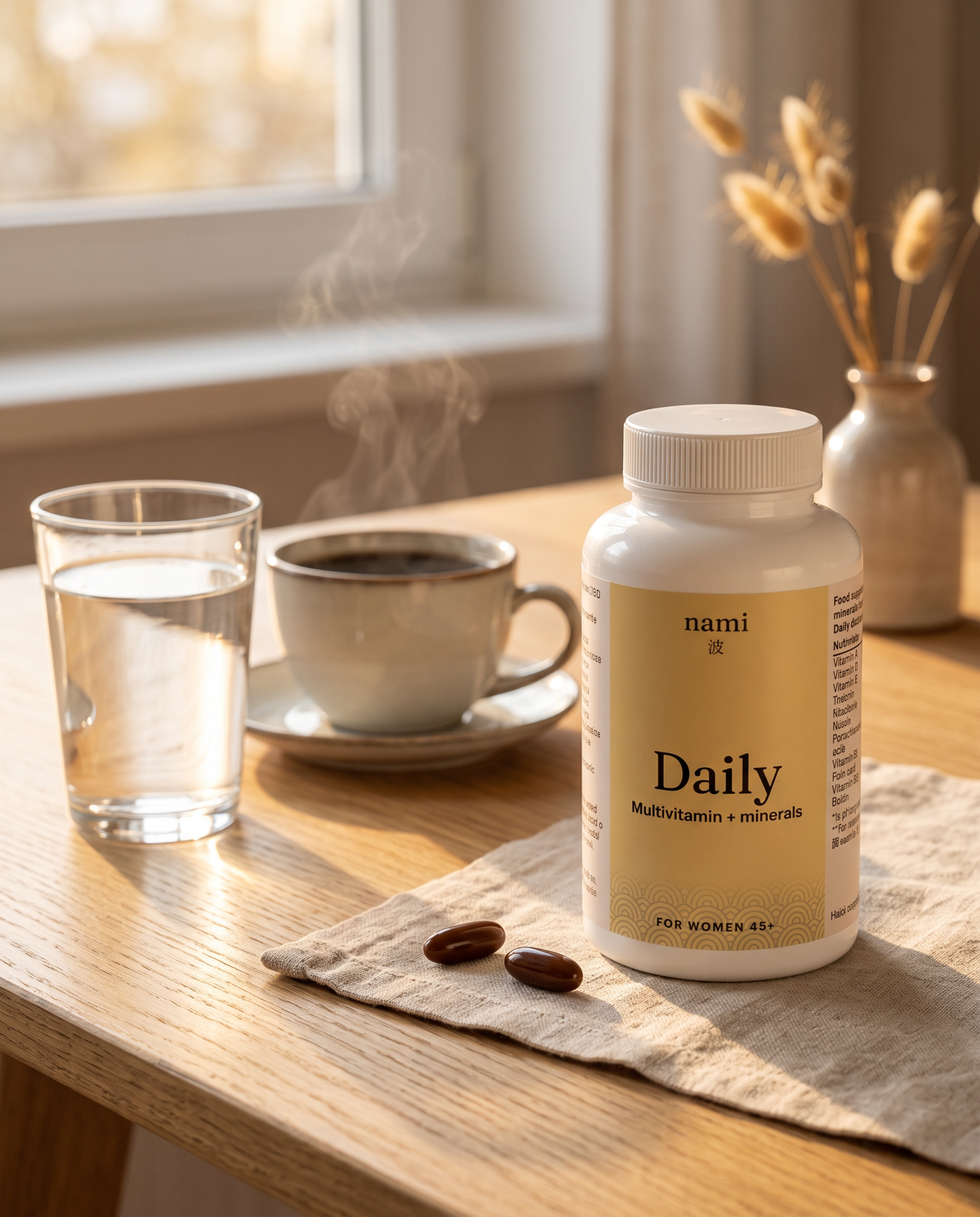
In the EU, a food supplement label has to show a fixed set of information. Once you know where to look, you can compare products in a minute.
The name
Every supplement is called a food supplement, usually followed by what is in it, for example “food supplement with vitamin D3 and vitamin K2”. The brand name and product name come on top of that.
The daily dose
The label states the recommended daily dose: how many capsules or how many grams, and how often. All amounts in the nutrition table are per daily dose, not per capsule. A product with two capsules a day lists what is in both capsules together.
The nutrition table and % RI
For vitamins and minerals, the table shows the amount per daily dose and the percentage of the reference intake (% RI). The reference intake is a reference amount for an average adult, set in EU law. 100% means the daily dose contains that reference amount.
A percentage above 100% is common and is not automatically too much. What matters for safety is the upper level: the maximum amount per day that is considered safe, set by EFSA. For vitamin D, for example, that is 100 µg a day for adults.
For ingredients without a reference intake, such as omega-3 fatty acids, creatine or coenzyme Q10, you see two asterisks (**) instead of a percentage.
The ingredient list
All ingredients are listed in descending order of weight, including the capsule and any anti-caking agent. Allergens, such as fish or milk, are shown in bold. Here you can also see the form of a nutrient, for example magnesium bisglycinate or magnesium oxide.
Health claims
A supplement may only say what a nutrient does if that claim has been assessed by EFSA and authorised by the European Commission, and only if the daily dose contains enough of the nutrient. Authorised claims are worded carefully: “vitamin D contributes to the maintenance of normal bones”. A promise that a product prevents or cures a condition is not allowed.
Warnings
Every label has to state that you should not exceed the recommended daily dose, that supplements are not a substitute for a varied diet, and that the product should be kept out of reach of young children. Many labels add specific warnings, for example about blood-thinning medication, pregnancy or vitamin A.
On our site, every product page shows the complete label text, so you can read all of this before you buy. See Quality and ingredients.
Sources
- Directive 2002/46/EC on food supplements.
- Regulation (EU) No 1169/2011 on food information to consumers (reference intakes, Annex XIII).
- Regulation (EC) No 1924/2006 on nutrition and health claims.